Garage Decluttering

Recycling and donation

Garage items sent to reuse charities and the right recycling streams instead of landfill: furniture, bikes, tools, metal, wood and electricals.

In short: Recycling and donation means unwanted garage items are separated so that usable goods go to reuse charities and community projects, and metal, wood, cardboard, garden waste and electricals go to the correct recycling streams, with only the remainder sent for disposal. It suits anyone who wants their clear-out to keep as much as possible out of landfill. It is usually included in the clear-out price.

Get a free quote

Fixed price, no obligation. We aim to reply the same day.

By sending this form you agree to be contacted about your enquiry. See our privacy policy.

Recycling and donation

A large share of what comes out of a typical garage can be reused or recycled. Working bikes, hand tools, garden equipment and solid furniture are often wanted by charities, furniture reuse projects and community schemes. Scrap metal, wood, cardboard and garden waste all have their own recycling routes. Electrical items, from old drills to fridges, must go to WEEE recycling rather than general waste.

Reuse depends on what organisations will accept. Many charities need items to be clean, complete and in saleable condition. Upholstered furniture usually needs its fire safety label, and some only accept electrical items that have been safety tested. We set aside good items for reuse where an outlet will take them, and are honest when something is better off recycled than donated.

What is included

  • Identifying items in good enough condition for reuse
  • Taking suitable items to reuse charities and community projects where accepted
  • Separating scrap metal for metal recycling
  • Separating wood, cardboard and garden waste
  • Sending electricals and white goods to WEEE recycling
  • Keeping general waste to what genuinely cannot be reused or recycled
  • A waste transfer note for waste removed

Who it is for

  • Households that want to avoid sending usable items to landfill
  • Clearing a parent's or relative's home where items still have life in them
  • Garages full of bikes, tools and furniture in decent condition
  • Garages with old electricals and white goods
  • Landlords and executors clearing whole properties

How much does it cost?

As a guide, recycling and donation are usually included in the clear-out price, which typically runs £150 to £350 for a moderately full single garage. Fridges, freezers and other items needing specialist recycling can add a separate charge. See our full cost guide.
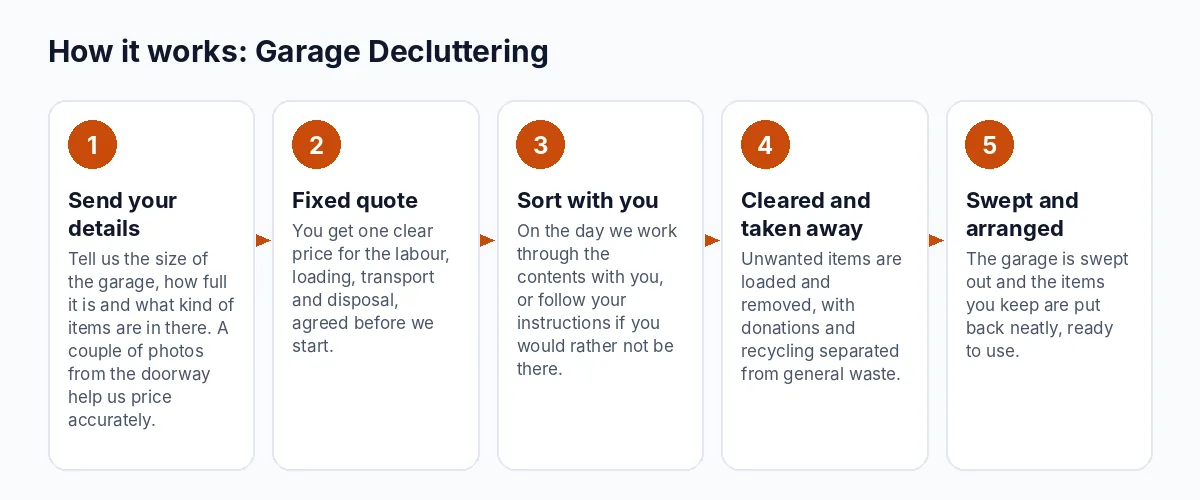
How it works

How recycling and donation works, step by step
  1. Identify reusable items

    During the clear-out we pick out furniture, bikes, tools and household goods that are clean, complete and likely to be accepted.

  2. Separate the streams

    Metal, wood, cardboard, garden waste and electricals are loaded separately from general waste.

  3. Deliver to outlets

    Reusable items go to suitable charities or projects, and recycling goes to licensed facilities.

  4. Dispose of the rest

    Only items that cannot be reused or recycled go for general disposal through licensed sites.

Recycling and donation: FAQs

Will charities take everything that still works?

No. Charities can only take what they can sell or pass on, so items need to be clean, complete and in good condition. Many will not take upholstered furniture without a fire safety label, cot mattresses or car seats, and some only take electricals that have been safety tested. Where a charity will not take something, we look for recycling instead.

Can I get proof of where my items went?

You receive a waste transfer note for waste removed, which records what was taken and the carrier's details. Charities sometimes give a receipt for donated goods. If knowing exactly where items end up matters to you, mention it when booking and we will tell you which outlets are being used for your clear-out.

What happens to old electricals?

Electrical and electronic items count as WEEE and must not go to general waste. They go to authorised treatment facilities where metals, plastics and components are recovered. Fridges and freezers are treated separately because they contain refrigerant gases and foam that must be handled properly. If you are buying a new appliance, the retailer may also take the old one back.

Can paint be donated?

Usable leftover paint can sometimes go to community paint reuse schemes, which pass it on to local groups and households. Many household waste recycling centres accept paint too. Solvent-based paint and nearly empty tins are dealt with differently from usable water-based paint, so we sort tins by type and condition before deciding where they go.

Get a quote for recycling and donation

Send a few details and get one clear, fixed price, usually the same day.

Get a quote

Last updated 6 November 2026